

Two band blocks…both are exactly 55cm…what is this “hat magic”!?
Ahh, ovals! That long forgotten topic that is spoken softly and almost never mentioned in those flashy social media posts you see around. Mentioned loudly, you may get some people to nod their heads, perhaps thinking “Yes, I’ve been there...”, while others meet you with blank stares. A funny thing ovals are, as they make some people stop using hats because they cannot find their size (even though the hat has a label saying it is their size), and make others pursue hat making (or both). That was actually my case. So get yourself comfortable, grab a cup of coffee, tea (or your favourite drink if it is that time of the day), and let me tell you a little story.
Back in the depths of the COVID19 pandemic, I decided to upgrade from my generic XL Levis cotton trilby, and get my first “real” fur felt hat (more on that Levis trilby below). In October 2021, with my wife we visited a beautiful hat store in a lovely small town in Ontario (not saying names here), and I settled on a Stetson fur felt trilby model. With fall weather making its appearance right on cue, that day it was raining like if you were sitting below Niagara Falls, so we had the entire store for us…a hat haven! What followed was about 30 minutes of me trying out the same hat model, in two different colours, oscillating between two sizes (my exact size, and one size up).
As much as I have tried, I could not dial in the perfect fit. My actual sized hat felt snug in the back and front, the size above felt way too loose at the sides. The attendant was nice enough to give me foam sweatband inserts, so I tried that with the larger sized hat. Still not good. It actually felt worst.
So after all this flip-flopping (and driving my wife impatient), I went with the colour I liked more, in my exact size, because well, I am a stubborn engineer and numbers are there for a reason. I felt like I always had felt whenever I tried out a nice brimmed hat: it felt tight, or loose, never quite right, and silly. It was like that my entire life. So, as many of other folks who struggle with hats, I always shunned brimmed hats and whenever someone said “hat”, I thought instantly of baseball caps. I always felt a little envious of those folks who could wear those dashing fedoras and said “this is the most comfortable hat I’ve experienced, bar none”. I was thinking “where do they get their hats from?”, or “I must have a deformed head since no brimmed hat will fit me”.
That Levis cotton trilby is the hat you imagine: mass produced, all cotton-y, black, and shaped in an industrial mold, the exact same shape as its 100,000 companions sold worldwide. But I loved it. I got that hat in 2012, and it saw a lot of travel and action. And it fit me well. The Stetson Trilby was amazing: rabbit fur felt (“it feels so nice!”), lined, leather sweatband, a real hat. But every time I wore it it was the same thing: a bright red mark in my forehead betrayed my nascent hat wearing habit for several minutes after I took my hat off. It was painful, not like the cotton Levis one.
So I was lost. I have just spent a good coin on a real fur felt hat, and it hurts? What is going on here? Being the stubborn engineer I am (yes, I said that above but the concept needs reinforcement as sometimes it takes me into unexplored paths), I thought the best way to find an answer is to do what I was doing at the time (being a graduate student): research. So, deep into the rabbit hole of hat sizing, custom hats, and hat wearing I went. And I still remember the day that all that info clicked in my brain. It was a rainy Friday afternoon in November (yes, it always rains in Ontario during Fall) when I learned a concept called ovals. I was mesmerized. It then dawned on me…my sizing was spot on, but my oval was off. And so, on that rainy afternoon, I set foot on the “hat making trail”, as many have done before me.
So what do you mean by oval?
As like any other piece of wardrobe, hat size does not tells the whole story. In hat making, oval refers to the ideal shape of one’s head, as seen from the top. I say ideal because our heads (like our bodies) are not perfectly formed geometric forms.
Like the name implies, oval is an ellipsoidal shape that can vary in form depending on its semi-major and semi-minor axes length (the two axes that define an ellipse). If they are exactly the same, the shape is a circle, or how it is known in hat making, a round oval. When the semi-major axis starts becoming larger than the semi-minor, one gets an ellipse shape, and as this difference grows, different types of ovals are obtained. This is where things become interesting.
Roughly speaking, there are typically four oval types somewhat standardized in the hat industry [1,2]:
Round oval (also known as wide oval, or broad oval);
Regular oval;
Long oval;
Extra long oval (sometimes egg oval, or slim oval).
Like shoe sizes, or clothes sizing (gasp!), the exact measurements for what a regular oval, long oval, and extra long oval are not exactly the same from one manufacturer to the other. Even the terms are not exact science either. Some call long ovals egg shaped (I have two vintage flanges stamped like that). I do not think this is an accurate description, as an egg form is different from an ellipse, but again, I am a pesky engineer that insist on using pesky engineering terms, so there is that.
Hat block manufacturers can also have different varying degrees of oval shapes. In fact, one of our block suppliers have a whole range of oval options to choose from, and if you are not satisfied with that, you can always go custom [1].
So where do we draw the line? Well, the answer is not that simple. For the hats I craft, I usually consider the following semi-major axes ratios (i.e. the relation between the major and minor semi-axes):
Close to 1, the answer is straightforward: round oval.
Around 1.25, a regular oval is a close match. This is actually one of the somewhat agreed relationships for regular oval across the industry; some go a little more round, some go a little more longer oval.
At 1.33, a long oval is recommended. This varies from manufacturer to manufacturer, and while some do not consider this a long oval, others call this extra long oval.
Above 1.4 one is entering what I do actually call extra long oval territory.
Oval missmatch
So all this is very informative, but why am I going into the nitty gritty details here? There is a surprisingly straightforward answer: because wearing the wrong oval has effects on the shape of the hat, and may become uncomfortable to the point where you want to toss your hat to the garbage. That was me a few years ago. I am a long oval, and all my life tried to fit my elongated big noggin into a more circular shape, and things simply did not worked out.
To demonstrate this, I am self referencing myself here, and borrowing two diagrams from the Sizing section in this site…that I am sure you did not read, because why bother right? ;)
The first one shows an overlap of long oval and regular oval shapes.
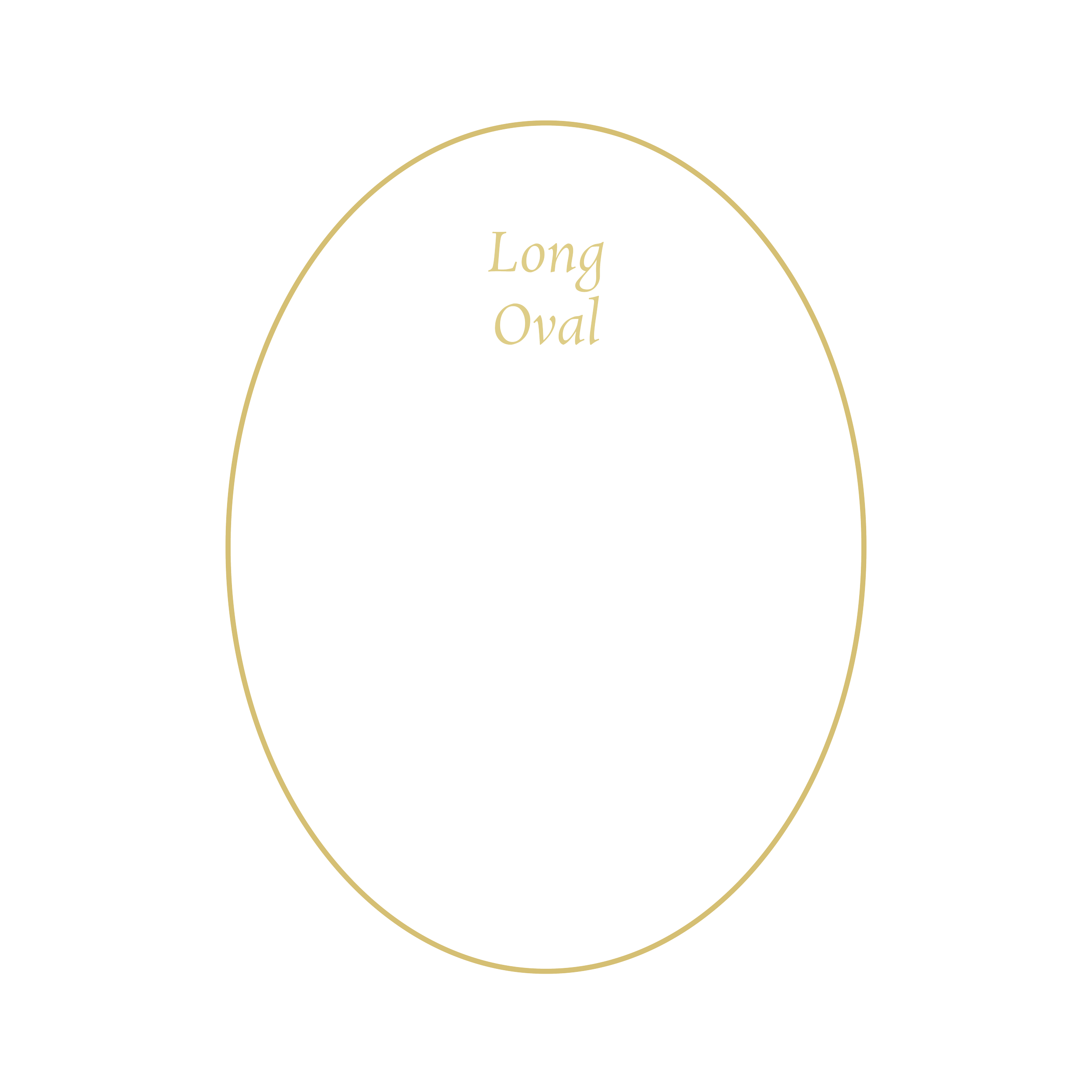
A regular and long oval shapes overlapped for comparison
It is clear that wearing a regular oval when one’s head is closer to a long oval creates two pressure points: one at the front, and one at the back of the head. Likewise, doing the opposite creates pressure points on the side of the head. The next figure shows exactly this, and I can already see some of you thinking “That’s where that infamous red mark in my forehead is coming from!”.
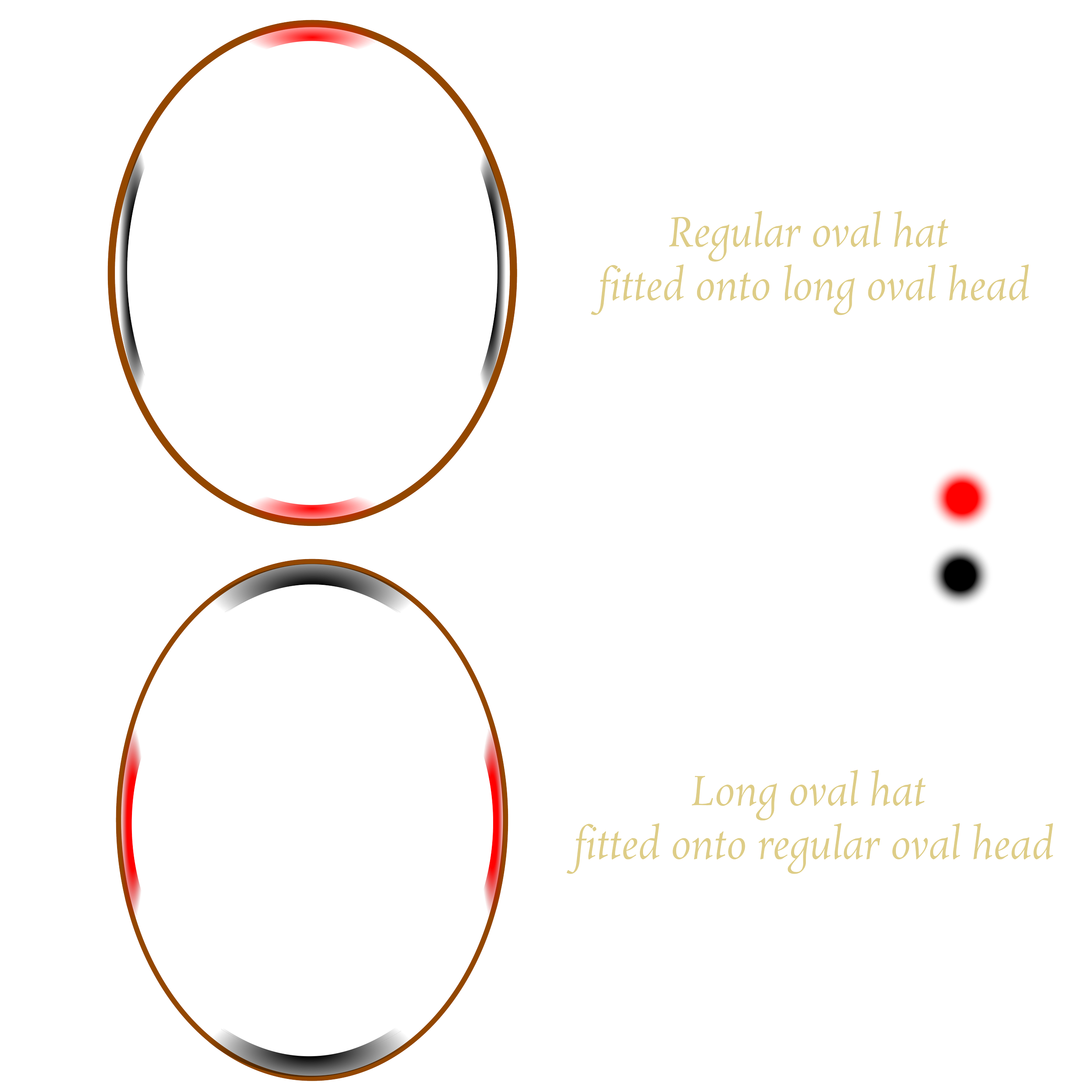
Wearing the wrong kind of oval…I can already feel the pinch!
Indeed, this was the reason of why I spent 30 mins just donning on and off the same two hats from my head in that shop back in 2021. The regular oval in my size was too tight back and front, because at the time I did not know that I had a long oval shape. The quick shortcut offered at the store was to take the next available size that fitted large (the gaps on the sides were so large you could fit a finger at each side), and fill in the gaps with foam. Not the most elegant solution. It also has the added disadvantage that the sweatband puckers, and then you have these unsightly ripples that do not sit properly on your head, and become a nuisance after a while.
As with any proper tailored suit, trouser or shirt, what is most important in these cases is fit. Comfort is a byproduct of fit: if your hat fits properly because it is the correct shape, you will barely feel something is in your head. Do the opposite, and I can guarantee from experience that you will throw that hat a few minutes after you develop a headache due to the pressure of the sweatband in your forehead (or temples).
Effects on the hat shape
Ok, so wait a minute. I thought we were talking about soft dress hats here, right? Indeed we are. And this proves a little bit towards our advantage.
As soft felt hats tend to conform (i.e. to adjust) to one’s head with time and use, if you are lucky to have an oval shape that is close to the oval the hat was made, it will eventually fit well. That happens in many occasions were that off-the-shelf hat you just bought from the store feels slightly off, but not to the point of being uncomfortable. You take it home, you wear it, sweat a little on it, and eventually you get to feel it becomes more contoured to your head shape and feels more comfortable.
What is happening here is that heat and moisture (the key elements to shape a hat) slowly work the hat shape in small ways to better fit the mold it is being put onto, a.k.a. your head. You can feel the inverse effect when you stop wearing your hat for say, a few months, and when you get back to it it feels slightly off, specially if it was stored in a hot and humid environment: the felt in the hat is trying to get back to its original shape (a round cone).
While the hat sweatband and crown base tries to conform to your head, the brim takes this opportunity to go places. Yes, it alters its shape [3].

A wonky brim…a regular oval being pushed back and front by a long oval shape
As seen in the picture above (exaggerated for demonstration purposes), a long oval shape forcing its way into a regular oval brimmed hat will introduce a distortion in the sides of the brim. These can be minor, or perhaps masked by snapping the front of the brim downwards, but they are there nonetheless. Sometimes, they add a little bit of panache to the hat and makes the entire shape to look better, but most often it tends to distort the brim and frustrate the hat wearer [3].

A wonky brim pt. 2…this time a long oval being pushed sideways by a regular oval shape
Likewise, trying to fit a regular oval shape into a long oval hat creates a similar distortion, but on the front and rear of the hat. This effect usually tends to “upturn” the downturned brim on snap brim models if the cupping of the brim is shallow and the brim is short (e.g. on a Trilby hat).
A short note on conforming
At this point I know that several of my readers are asking themselves: “has this guy never heard of a formillion?” The answer is yes, I know about such contraption. Paired with its partner in crime, the conformateur, these tools allow to capture the exact shape of the head, and conform the hat to that shape during manufacturing.
For those who are not familiar with these tools, a conformateur (loosely translated as shape conformer) is a large ring with several adjustable small keys or “teeth” (do not worry, they do not bite) that is placed on a person head to obtain the exact heat contour shape. The formillion (translated as shape former in my mind…sorry, there are no official translations for these hat making terms) is the complement: imagine a hat band block like the ones on the first picture of this article with many adjustable teeth, similar to the conformateur, that allows to adjust the shape of that band block to a very specific shape, and then being used in the hat to make it fit that shape perfectly. I will not get into the details of how this works (that is material for another article), but hopefully with this description you get an idea, and are aware that yes, a custom hat can be easily fitted to any head shape.
So why not use a conformateur to take the measurements from your customers, and then use a formillion to shape the hat? Well, this is easier said than done. I will not bore you with the logistics of doing this for customers located far away, but with soft dress hats this approach is hardly needed if the oval is close to the customer’s head shape. I know this is a controversial statement in this age where for each two Instagram videos of a hat felt being set on fire there are videos of folks using these tools to create custom band blocks that they send out with hats (or put the name of someone famous to brag about having a famous customer).
For stiff hats such as Western, Bowlers, and Top hats, a conformateur-formillion set is a must and needs to be used for a proper fit, as these hats are hard as a rock at the sweatband crown area, and do not naturally conform to one’s head. But this is not the case for soft felt hats, and I will go a little bit further on this topic on a future article (stay tuned!).
To be very clear: if the hat is made in soft felt, and the head shape is close to the correct oval, the hat will naturally conform to the true head shape as one wears it.
All this is nice, but what can I do about it?
Neglecting to mention ovals in any sizing guide or in person consultation is a hat crime. Ok, let’s not be that harsh. Not a crime as per the dictionary definition, but as it was my case, neglecting this information is like saying “shirt sleeve lengths are standard for shirts” (they are not, this is also another one of my struggles).
For those out there that have written about this, talked about this, or offer alternatives in different ovals, my most sincere thanks! You are making people like myself who struggled with this topic feel like they do not have a deformed head, and making them to keep wearing those dashing hats.
If you are a hat maker and until today were not aware of ovals, their impact on fit and shape, and what to do about it, now you know. I am surprised to see that the majority of folks who enter this craft (and many who have been at it for decades) have no idea about the concept of ovals. I have also noticed that some decide to omit this topic because they do not want to go to the efforts of tooling up to meet their customers requests, because they want to keep this as “trade secret” (please do not do this), or simply because it is something else to take care of while they are piled up with orders.
In all the hat stores I visited in my life, not a single one employee told me about this, or even asked when we were discussing sizing (granted, I may not have visited the right hat stores). Later I discovered that with a few exceptions, every single large hat manufacturer currently in operation has no option for any oval different from the standard one they offer (that not even them know which one that is). This was my lifelong struggle with hats, and I have met many others who also struggled with this.
It is important to understand also that ovals vary with regions due to the regionalized differences in head shapes [4]. This is a struggle also for manufacturers that supply hard headwear and other protective gear such as motorcycle helmets and hard hats, many who have started to adopt different ovals options for their customers.
If you are a hat aficionado, and enjoy wearing hats, the oval of the hat together with its size will dictate your best fit, and a hat that fits well is a joy to wear. I have been there. My journey into hatmaking started when I noticed that no big brands offered long oval, so I would had to take the custom route. I looked for custom hat makers around where I lived, and the ones who crafted the dress styles I liked had retired or lived too far from where I was located. At that point I started asking myself how much effort will it take to make my own long oval hat, and I would definitely not be here if it were not for pursuing the perfect fit. The first time I tried on my first hat (built specifically to my head shape) was a moment of realization.
As with any bespoke piece of clothing made to order, find out about your oval and exact size, and keep pursuing those hats that fit as perfectly as a chilled Martini on a Saturday evening.
As for that Stetson Trilby, after some years of wear (and some persuasive sessions with a band block), it nows fits like it was meant to fit, without any distortion of any kind. It has now taken the place of that (in)famous Levis cotton trilby.
So if you see me around wearing a dark grey Trilby, now you know that the little hat tipped me unexpectedly into this craft, and I could not be more happy about it!
See you soon!
(tip of the hat)
Sources
[1] Guy Morse-Brown, “How do I know what hat block form to order?”, https://www.hatblocks.co.uk/how-do-i-know-what-hat-block-form-to-order/, retrieved on August 20th, 2026.
[2] Stratton Hats, “Buyer’s Guide”, https://strattonhats.com/buyers-guide/, retrieved on August 20th, 2026.
[3] Brent Black, “What is Long Oval Blocking?”, https://www.brentblack.com/what-does-long-oval-mean.html?srsltid=AfmBOoqgv1t4dzExf8EWYCwq0_wcRjh9n8wP4vvlm8Yao2WHXi0R27p5, retrieved on August 20th, 2026.
[4] R. Ball et al., “A comparison between Chinese and Caucasian head shapes”, Applied Ergonomics, Vol. 41, 2010, pp. 832-839.
